History of the Lineages
The Lineages of Brussels
The Lineages of Brussels !
The lineages of Brussels date back at least to the 13th century. Indeed, at the beginning of the 14th century, more precisely in 1306, Jean II, Duke of Brabant, promised the lineages to "restore" them to the monopoly of the administration of the city they enjoyed, he specified, "under his father, his grandfather, and his ancestors."
In the Brabant cities, the lineages grouped together privileged families who shared between them the aldermanic functions. Membership in this kind of oligarchy transmitted through all lines, both through women and men. It is generally believed that it was based on the ownership of urban land.
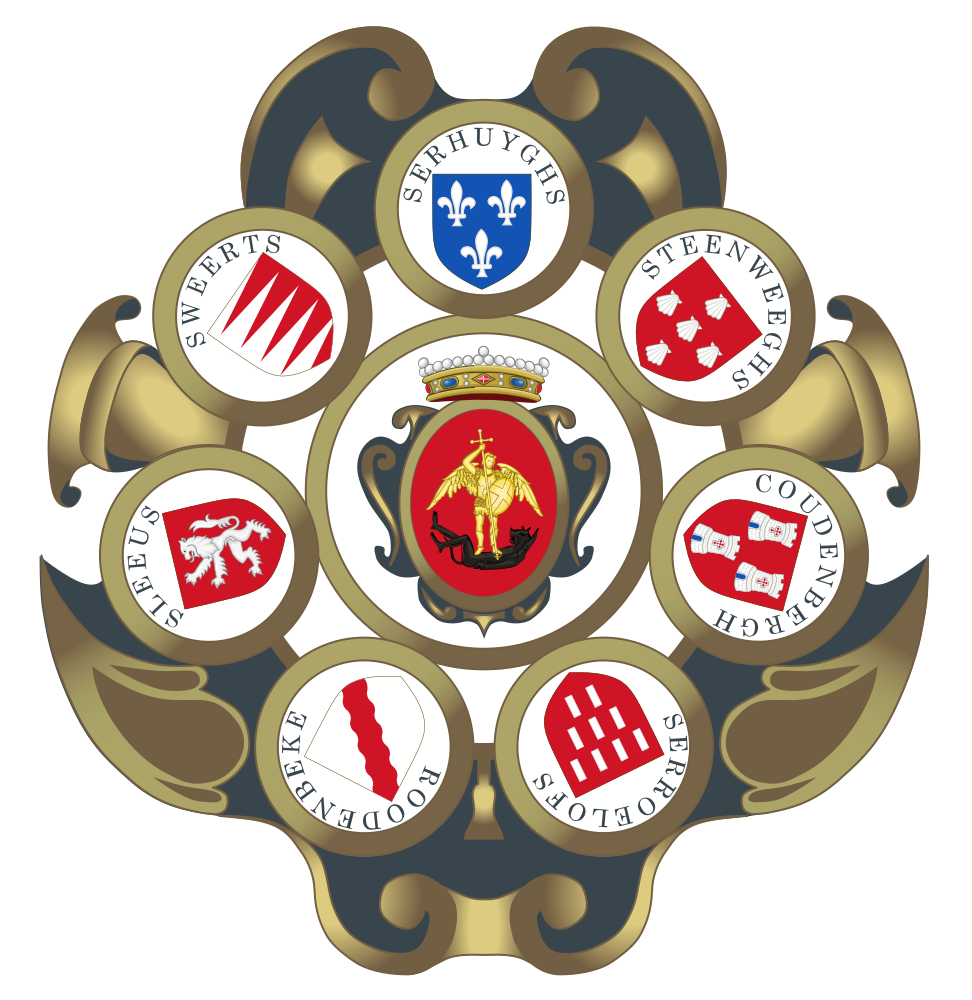
There were seven lineages in Brussels. They bore the following names: Coudenberg, Roodenbeke, Serhuyghs, Serroelofs, Sleeus, Steenweeghs, and Sweerts.
Admission to the lineages
To be admitted to a lineage, one had to prove that one descended, in all lines, that is to say both through women and through men, from a person received into the lineage. It was also necessary to prove that one was born, baptized, and raised in "the true Catholic, Apostolic, and Roman religion."
Each reception resulted in the establishment of a report specifying all the information about the origin of the admitted person. These documents constitute a precious source for tracing the genealogical history of Brussels families.
The Seven Lineages
Coudenberg
Historical lineage
Roodenbeke
Historical lineage
Serhuyghs
Historical lineage
Serroelofs
Historical lineage
Sleeus
Historical lineage
Steenweeghs
Historical lineage
Sweerts
Historical lineage
Lineage affiliations
Since 1998, our members have undertaken the systematic publication of lists of members of each lineage. These lineage affiliations provide access in a few moments to valuable genealogical information. They also reveal the family ties that united these families with each other and with other families of European nobility.
Each volume of the collection "Lineage Affiliations" consists of three parts:
- A historical part that traces the history of the concerned lineage
- A documentary part that publishes the entirety of the reception records
- A genealogical part that includes all known lineage affiliations
Organization and evolution
The lineages were organized into companies with internal structures. Each lineage elected its representatives who sat on the City Council. This organization ensured the representation of different noble families in urban governance.
Over the centuries, the political role of the lineages evolved, but their social and symbolic importance remained. Today, the association of The Lineages of Brussels perpetuates this historical tradition and keeps alive the memory of these great families.
“Lineage descent, transmitted both by women and men, remains an important part of Brussels' history and identity.”
Christophe DE FOSSA